Traditional research tells us what people think, how widely opinions are held and why. But how do we know whether we are asking the right questions in the first place?
Social listening offers a valuable starting point. By examining conversations people are already having online, researchers can identify emerging concerns, understand the language people use and uncover issues that existing questionnaires may overlook.
The value lies not in replacing conventional research, but in making it more relevant and responsive.
From online conversations to better questions
To illustrate this approach, Investimate examined Arabic-language online conversations originating from Syria about the potential return of ISIS.
Using Brandwatch, the analysis covered December 2024 to August 2026, identifying 926 distinct mentions after deduplication.
The objective was to compare emerging online narratives with the themes covered by an existing annual research questionnaire and identify what should be retained, updated or added.
What the analysis revealed
The exercise highlighted three important areas:
Keep established measures: Existing questions on ISIS attacks, operational strength, local support and international involvement remained relevant.
Update the framing: Conversations pointed towards the importance of institutional capacity, detention arrangements and changing security responsibilities.
Explore emerging concerns: The issue of ISIS detainees appeared in 170 mentions from 98 authors, representing approximately 18% of the analysed texts. This suggested a potential gap in the existing questionnaire and an issue worth investigating further.
Economic hardship also emerged as a possible factor to test in future research, although explicit references were too limited to support a firm conclusion.
These findings illustrate an important distinction: visibility in online conversations is not the same as prevalence in the population. The 18% figure does not mean that 18% of Syrians consider detainees a major risk. It indicates that the subject was sufficiently visible in the analysed conversation to warrant further investigation.
Better together
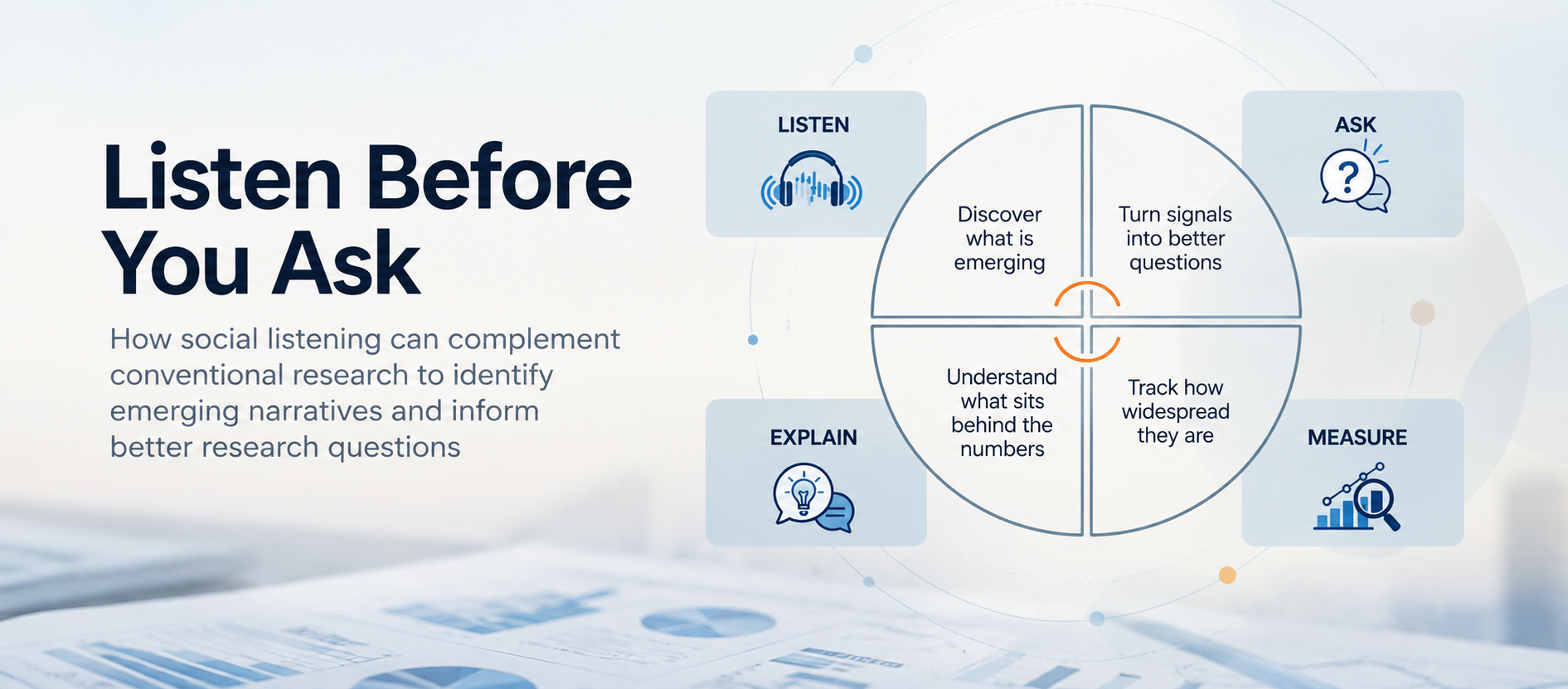
Social listening and conventional research serve different but complementary purposes.
Social listening helps identify what is emerging. Conventional research helps establish how widespread those concerns are, who holds them and why.
By bringing the two approaches together, researchers can move from discovering signals to asking better questions, measuring their significance and understanding the reasons behind them.
The principle is simple: Listen first. Ask better. Understand more.